
The publication process will likely take us into early 2019.
The process took a little longer than planned because IEEE wanted the 803.2bt standard to be backward compatible with all PoE devices.
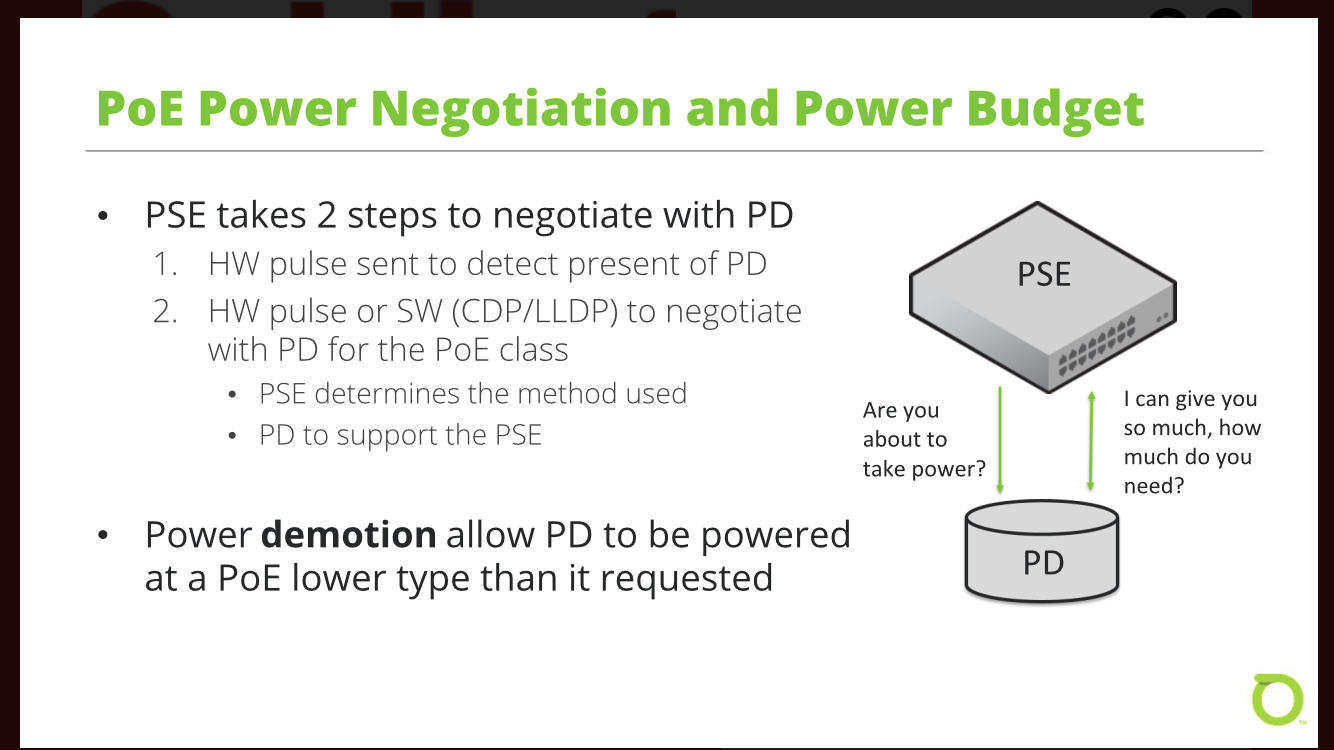
Now that it’s a standard, we wanted to answer a few common questions about IEEE 802.3bt.
1. What will 802.3bt allow us to do?
As the newest PoE standard, 802.3bt calls for two power variants: Type 3 (60W) and Type 4 (100W). This means that you can now carry close to 100W of electricity over a single cable to power devices like wireless access points, thermal cameras with PTZ features, LED lighting fixtures and large display screens (and the list goes on).
As a frame of reference, the original PoE standard – IEEE 802.3af – allowed for maximum delivery of 15.4W. From there, IEEE 802.3at increased maximum power to 30W. IEEE 802.3bt allows for more than six times the amount of power than the original PoE standard created in 2003.
2. Why is 802.3bt important (or necessary)?
This ratification comes at the perfect time to support smart buildings and Internet of Things (IoT). To make these concepts a reality, making more power available to devices is required (along with more bandwidth to accommodate more wired and wireless devices).
Without PoE, smart buildings would be more expensive to design and build. Case in point: Instead of several different, standalone networks with their own wiring, connectors and pathways, single IP networks are being used. Before PoE, systems connected to IP networks required separate data and electrical connections, as well as proximity to electrical outlets. With PoE, one single cable provides data and an electrical connection (with power levels now close to 100W).
3. How is 802.3bt different than other PoE standards?
IEEE 802.3af and 802.3at standards call for power delivery over two pairs of a four-pair cable – using either pairs 1 and 4 or pairs 2 or 3 (but not both pairs).
IEEE 802.3bt takes advantage of all four pairs in a 4-pair cable, spreading current flow out among them. Power is transmitted along with data, and is compatible with data rates of up to 10GBASE-T.
4. What are the cabling requirements for 802.3bt?
Although the new standard states that Category 5e cable or higher is needed, it’s crucial that Category 6A 4-pair balanced twisted-pair cable is used with new 100W PoE installations for the best possible thermal and power efficiency.
Less power is dissipated in a Category 6A cable, so more of the power running through the cable is actually transferred to the device instead of being wasted. Some Category 6A cables are even designed with enough insertion loss margin to handle the extra heat generated when PoE cables are bundled. This extra margin ensures that your channel will still reach 100 m under maximum PoE load.
By running Category 6A cables to each powered device, and implementing a zone distribution architecture, you’ll create a futureproof infrastructure that supports 100W PoE along with higher data rates.
作者简介
Ron Tellas
Belden企业解决方案业务部高级解决方案架构师
Ron Tellas 是射频设计和电磁传播方面的主题专家,于 2016 年加入 Belden,帮助制定智能建筑技术和应用的路线图。 他现在利用这些经验将系统、设备和连接纳入网络解决方案。 Ron 代表 Belden 参加多个标准组织、国家电气规范委员会并担任 FMP 联盟的董事会成员。 他拥有电气工程硕士和学士学位、工商管理硕士学位,也是 17 项美国专利的发明人。 罗恩因其对电信行业的杰出和有影响力的贡献而自豪地荣获 2024 年 Harry J. Pfister 奖。