
3 Common Ethernet Failures that can be Avoided by Using Bonded-Pair Cable
With the rise of IoT devices, our network grew bigger and more complex, so does the probability and cost of network failure. Downtime could mean security systems that fail, machines that don’t work, or serious quality control issues. On top of all that risk, the cost of unplanned downtime can run into the millions for production facilities.
Consider the impact of choosing the wrong cable in the scenarios below:
- Motion: Physical changes to your cables will lead to permanent changes in electrical performance. Various installation conditions, frequent or continuous motions put physical strain on the wires, forcing one or more of the 4 twisted pairs to separate from each other. Even the simple act of simulating a service loop for a few seconds by bending a conventional twisted pair cable can cause failure.
As a visual example, twisting, bending and pulling cable is similar to how a paper clip bent back and forth is now altered with a permanent weak point created at the bend.
- Bonded-pair technology enables a 4xOD bend radius, compared to a 10xOD bend radius of regular Ethernet.
- With bonded-pair cables, contact is maintained between the twisted pairs creating an actual bond between the two wires, eliminating typical threat of separation.
- Bonded-pair technology enables a 4xOD bend radius, compared to a 10xOD bend radius of regular Ethernet.
- Force: It is nearly impossible for conventional twisted pair wires to maintain equal distance as cable is pulled, flexed or otherwise manipulated during installation and use. Long cable lengths are typically required in industrial settings which further exaggerates pull tension and signal failure.
- Bonded-pair cable is 40% stronger in terms of resistance to pull tension and can handle tight bends without compromising signal quality like when routing cables in cable trays or storing extra cable length in tight cabinets.
- Installable Performance™ - While many manufacturers show 100% quality testing right off the manufacturing line, Belden bonded-pair cables maintain performance after they are installed.
- Bonded-pair cable is 40% stronger in terms of resistance to pull tension and can handle tight bends without compromising signal quality like when routing cables in cable trays or storing extra cable length in tight cabinets.
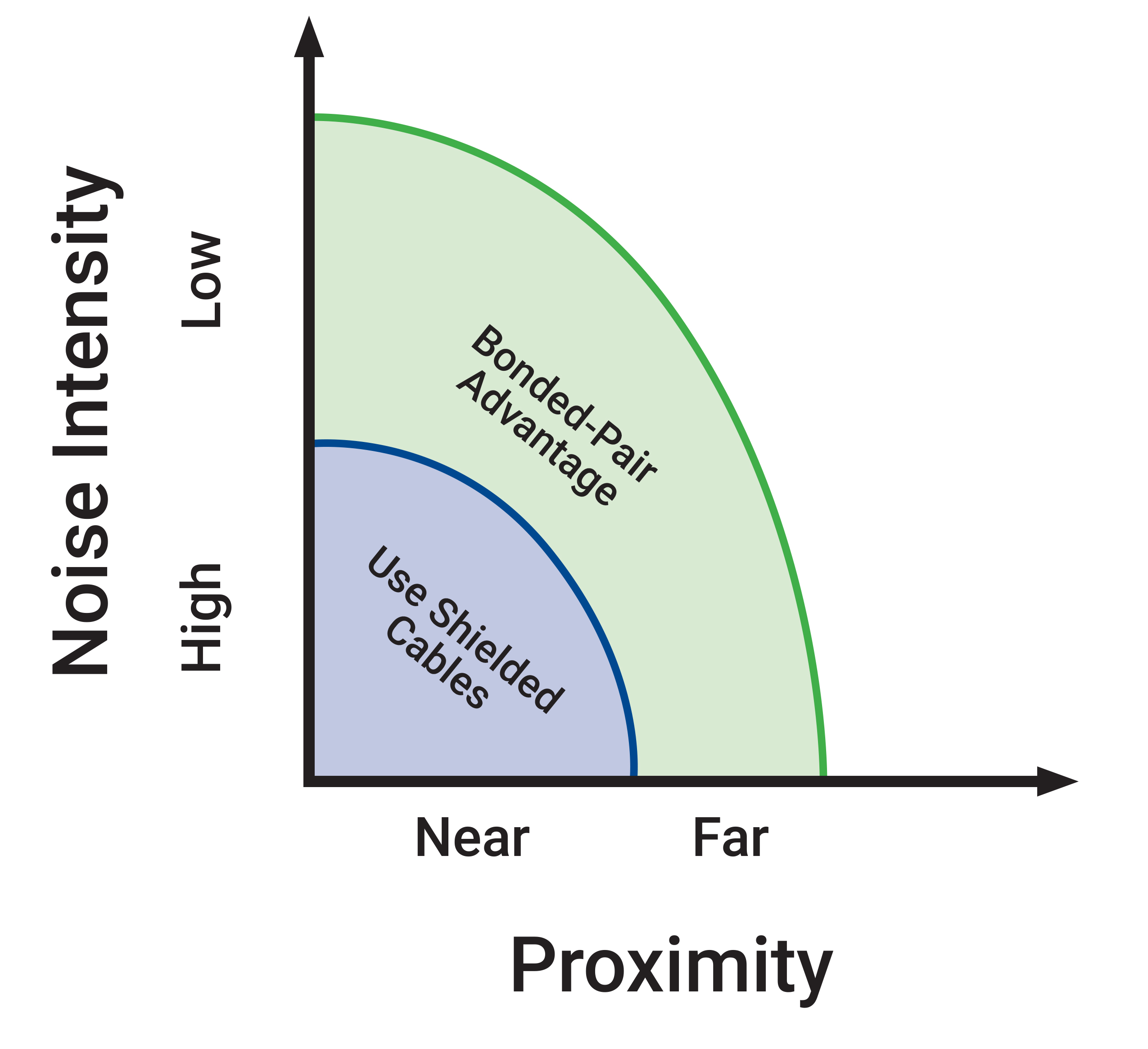 Noise (EMI or RFI): High voltage equipment such as motors, VFDs or welders near your Ethernet cables can cause signal disruption. Twisted pair is designed for noise cancellation and to protect the signal integrity. If gaps form in a twisted pair, noise on each individual conductor can no longer be cancelled completely.
- The design of bonded-pair maintains uniform and optimum conductor-to-conductor distance for all 4 twisted pairs throughout the length of installation.
- While shielding can provide outstanding noise protection; unshielded, bonded-pair industrial Ethernet cable is tested to outperform a regular foil-shielded non-bonded Ethernet cable in terms of noise immunity. Also, the bonded-pair design provides excellent noise protection, often at a lower cost, than cable shielding. Using bonded-pair cable can reduce cable cost, installation cost, time and complexity associated with correctly terminating and grounding shielded connectors.
- The design of bonded-pair maintains uniform and optimum conductor-to-conductor distance for all 4 twisted pairs throughout the length of installation.
How Bonded Pairs Provide Installable Performance™
At Belden, we have a saying for data cables: physicals = electricals. That is, changes in the physical form of the cable lead to permanent changes in electrical performance. This is why cable manufacturers go to such lengths to specify pulling tension limit and minimum bend radius. It is also why there are stringent installation guidelines from the Telecommunications Industry Association (TIA) on how much you’re allowed to alter the cable to terminate with an RJ45, M8, or M12 connector – only ¼ inch with experts needing only 1/8 inch of untwist.
For twisted pair cabling, keeping the exact same physical distance between each wire in the pair is the most important physical attribute to keep intact. This principle goes all the way back to Alexander Graham Bell’s original twisted pair telephone wire patent in 1881.
Belden invented a bonded-pair technology to further enhance the original twisted-pair patent. The underlying principle of this patented technology is to add another level of physical robustness to eliminate gaps. By bonding the individual conductors along their longitudinal axis, a solution was developed which guarantees uniform spacing within each twisted pair. In some cases where noise intensity is low and proximity to the source is far, you can eliminate the need for a shielded cable altogether by using Belden bonded-pair cable.
For Industrial Success, Specify the Right Cable

In today’s highly connected world, you can’t afford to be wrong about the cabling you choose, especially in an industrial environment. Personal safety, production output and profits are all on the line. The cost of even a single, relatively brief, cable failure at your facility can easily escalate into catastrophe.
作者简介
Sylvia Feng
高级解决方案顾问经理
作为 Belden 的高级解决方案顾问经理,Sylvia 热衷于应用新技术和用户友好的设计,使我们的工作变得简单、可靠和有意义。 她是客户问题的倡导者,过去十年一直在制造业中致力于精益六西格玛改进、开发、测试、推出和应用新产品。 她在运营、工程、现场应用和营销方面的经验确保了产品设计和生命周期管理中考虑到所有方面。