
We’ve said it over and over again in recent blog posts – and we’ll continue to say it: We’re connecting more devices and people to the network than ever before, and the numbers of LAN connections will only increase. IoT is officially here, taking disparate building systems and connecting them to the network via IP (internet protocol) to operate, communicate and integrate.
This opportunity allows us to save money, make better business decisions and add more minutes back into our days. Check out just a few of the benefits of convergence and integration:
- Building systems are easier to manage, operate and adjust
- The impacts of one building system on another can be taken into account through back-and-forth communication between devices
- Building systems can adapt to occupants’ needs in real time to improve productivity, safety and satisfaction
- Business decisions can be made based on solid data regarding how space and systems are truly being used
But as more connected devices move onto networks, our indoor environments – including LAN connections – have to adapt.
LAN Connections are “Headed Up”
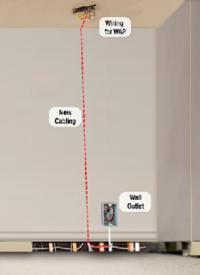 With upcoming higher-throughput wireless access points (WAPs) being introduced as part of the ever-changing LAN, the shift to wireless LAN is increasing at a fast pace. Next-generation Wi-Fi gear is 802.11ac Wave 2, which uses 160 MHz channels for better speed and performance, and allows multiple users to access the same channel. Wave 2 gear will break the gigabit barrier and support multi-gigabit Wi-Fi transmission, requiring access points and Ethernet switch ports to scale beyond 1G.
Because of this conversion, cable is coming out from behind the wall, where Ethernet 100M/1G is run to the workstation and terminated into a wall plate to achieve a LAN connection. The demands of IoT are creating a new kind of environment with all wiring and cabling in the ceiling, where Ethernet 2.5G/5G and ultimately 10G is terminated to a wireless access point; your devices connect to that infrastructure. Because 802.11ac calls for higher numbers of wireless access points to make sure large numbers of users can access multi-gigabit service, more cabling will be deployed overhead.
Consider Grid Cabling for Ceiling Infrastructure
Grid cabling for ceiling infrastructure and LAN connections can help make this idea a reality. To support the move from the wall to the ceiling, grid cabling brings your horizontal cable runs into zone boxes. Within these boxes are panels. From the zone boxes/panels, direct-connect assemblies connect directly to your devices, whether they’re WAPs, lights, displays, monitors, cameras, etc.
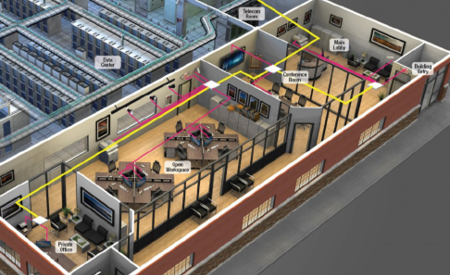
This enables easy moves, adds and changes; only the assembly from the box to the device needs to be changed. It can also help with futureproofing. If you install more runs than your space currently needs, you’ll be ready to add more devices to LAN connections in the future.
Belden offers complete solutions to support the mission-critical needs of LANs and their ever-changing demands. Also, be sure to subscribe to our blog!
作者简介
Ron Tellas
Belden企业解决方案业务部高级解决方案架构师
Ron Tellas 是射频设计和电磁传播方面的主题专家,于 2016 年加入 Belden,帮助制定智能建筑技术和应用的路线图。 他现在利用这些经验将系统、设备和连接纳入网络解决方案。 Ron 代表 Belden 参加多个标准组织、国家电气规范委员会并担任 FMP 联盟的董事会成员。 他拥有电气工程硕士和学士学位、工商管理硕士学位,也是 17 项美国专利的发明人。 罗恩因其对电信行业的杰出和有影响力的贡献而自豪地荣获 2024 年 Harry J. Pfister 奖。