
As a result of these changes, Power over Ethernet (PoE) is also on the rise. In fact, BSRIA predicts that more than 80% of wireless access points (WAPs) will rely on PoE as a way to transmit electrical power and data to remote devices over standard twisted-pair wire in an Ethernet network by 2020. Between 20% and 50% of other devices and applications – security cameras, access control systems, lighting and HVAC – are predicted to rely on PoE by 2020.
Taking the “Direct-Connect” Approach
As LANs transform and grow to accommodate these changes, simplicity will be key to avoid cumbersome installation and scaling challenges, and save time.
Using security cameras as an example, LAN infrastructure can be simplified when plugs are placed on the end of horizontal cabling and run straight out to an IP device. PoE cable can be directly connected to a camera without any connections in between – in this situation, it doesn’t make sense to deploy several other connections along the way.
This simplified type of connection method is one we like to call “direct connect.” It’s also known as a home-run connection or an end-to-end connection. This direct-connect method efficiently connects IP devices to the LAN. A single cable is used to connect a device at one end; the other end of the cable is connected directly to where it needs to be.
When you utilize horizontal cabling in this fashion, two things happen:
- More efficient power delivery due to solid, larger-gauge cable construction that permits higher output without applying additional power from the source
- Minimal insertion loss because the heat risk from bundles downstream is reduced
Direct-Connect Testing
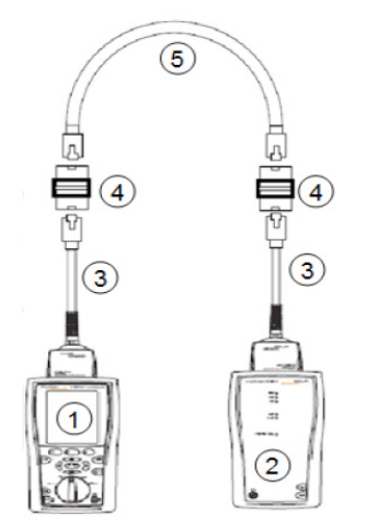 Main Tester
- Remove Unite
- Permanent Link Adapter
- Coupler
- Link Under Test
Although a direct connection can improve efficiency, simplify infrastructure and reduce complexity, there’s an important point to keep in mind: You can’t measure the performance of a plug using channel specifications on your field tester.
Channel specifications don’t include the plug on the end of the channel. When using a field tester with channel adapters for channel testing, the plug is essentially “subtracted out”; as a result, you didn’t get to see the performance of the plug on the end of your cable. Because direct-connect cabling likely uses field-attach plugs, a slight modification to the field test is required, using pigtails, to ensure that the plug was installed correctly.
Alternatively, you can use ISO test limits, which are available on testers labeled as TR11801-99-2. This method utilizes patch cord adapters, and does the calculation to include the plug on the end of the channel.
Direct Connect and Grid Cabling
Using a direct-connect method in combination with grid cabling will bring you the same benefits as an entire direct-attach assembly. In this scenario, horizontal runs are pulled to zone boxes. Within these zone boxes are patch panels. Assemblies are deployed from these boxes/panels to connected devices: WAPs, lights, monitors, cameras, printers, displays, etc. When devices are added or moved, the assembly from the box to the static end device is the only thing that needs to be changed. (Check back in a few weeks to learn more about grid cabling in a new blog post.)
To better support direct-connect field assembly, Belden is releasing a new product this month that’s ideal for use with bonded-pair cabling. A core that accepts either a plug or a jack body is installed on the cable, providing an added level of versatility and reliability to support the ever-evolving LAN. The product is optimized for connectorizing horizontal cabling with either a plug or a jack.
Make sure you sign up for our blog to be the first to hear about this new Belden product.
作者简介
Ron Tellas
Belden企业解决方案业务部高级解决方案架构师
Ron Tellas 是射频设计和电磁传播方面的主题专家,于 2016 年加入 Belden,帮助制定智能建筑技术和应用的路线图。 他现在利用这些经验将系统、设备和连接纳入网络解决方案。 Ron 代表 Belden 参加多个标准组织、国家电气规范委员会并担任 FMP 联盟的董事会成员。 他拥有电气工程硕士和学士学位、工商管理硕士学位,也是 17 项美国专利的发明人。 罗恩因其对电信行业的杰出和有影响力的贡献而自豪地荣获 2024 年 Harry J. Pfister 奖。