
When comparing 40G vs. 100G optical transceivers currently available in the market, both have been developed and cost optimized for their designated reach and applications.
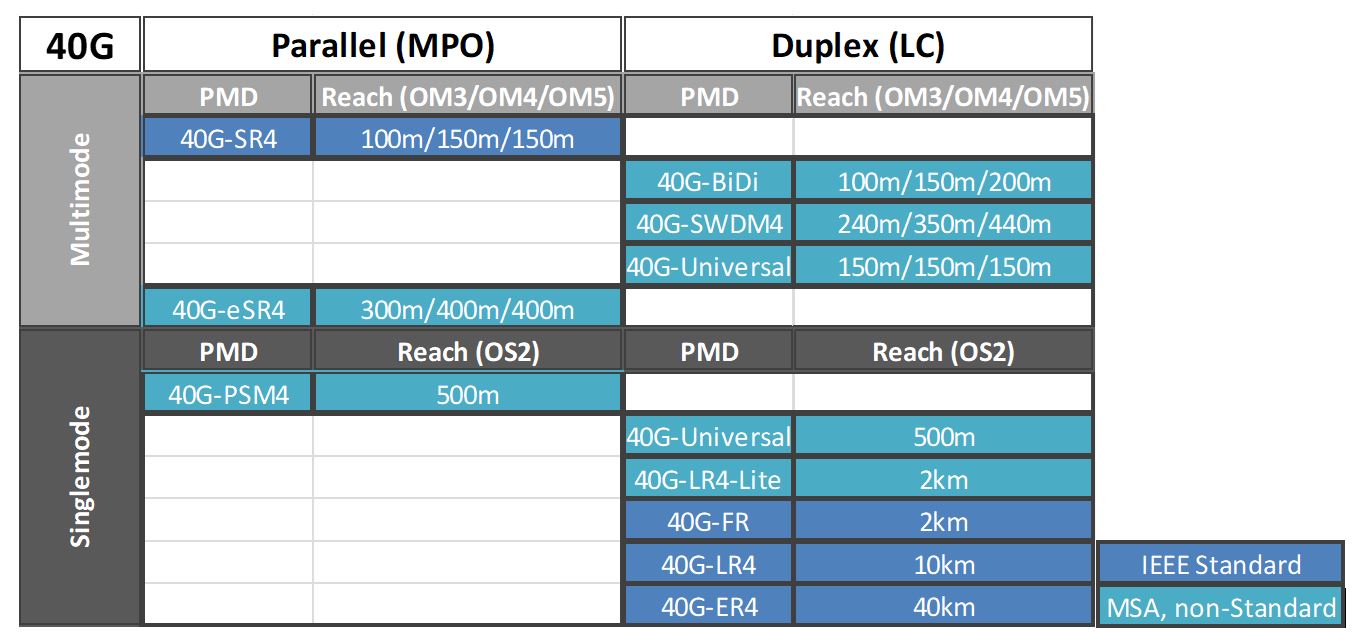
40G Transceivers and Reach Specifications
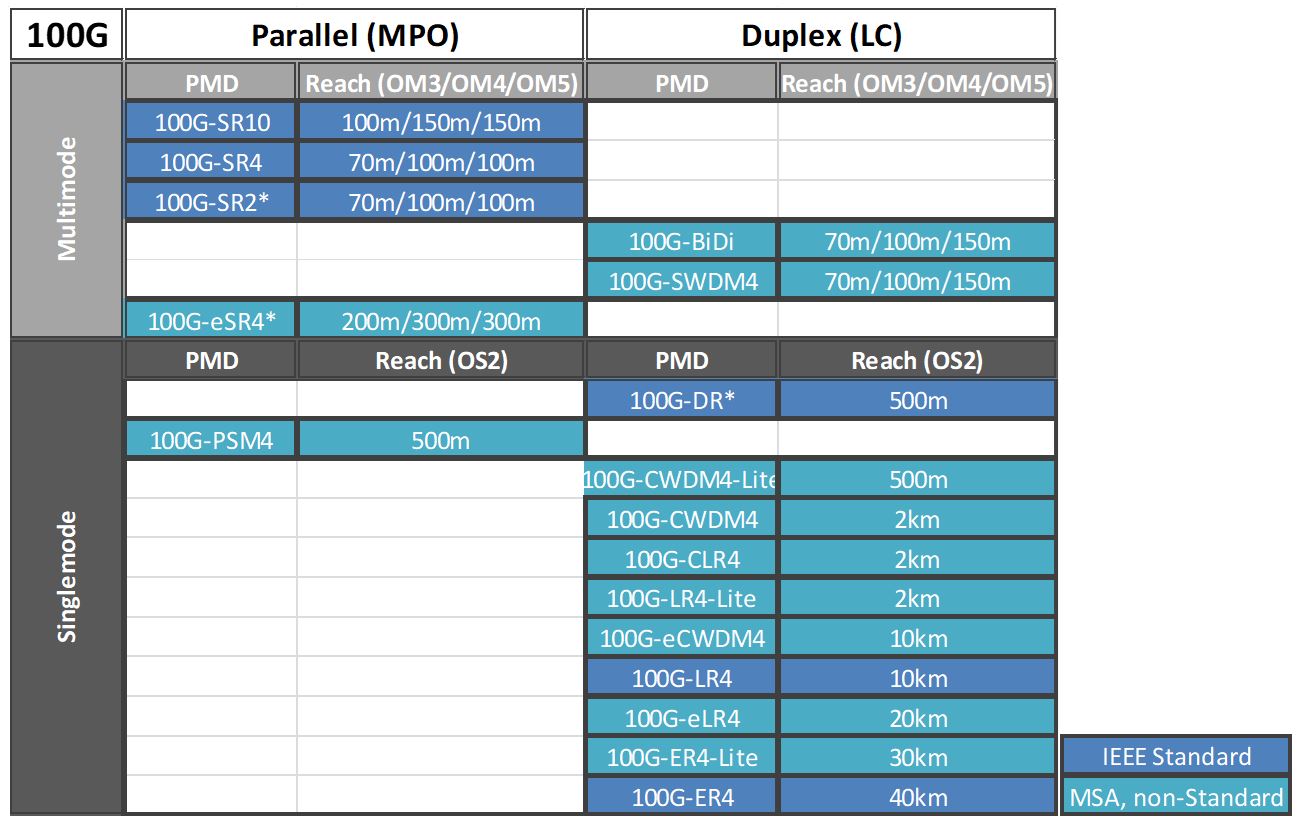
100G Transceivers and Reach Specifications
While weighing 40G vs. 100G Ethernet, and deciding which migration path makes more sense for your organization, here are some facts you should know:
- Switches with 10G SFP+ ports, or 40G (4x 10G) QSFP+ ports, can support 10G server uplinks
- Switches with 25G SFP28 ports, or 100G (4x 25G) QSFP28 ports, can support 25G server uplinks
- 100G switches have already been massively deployed in cloud data centers; the cost difference between 40G vs. 100G is small
- Most new 100G transceivers can easily support 40G operation
- Some non-standard 100G singlemode transceivers are designed and optimized for cloud data center deployment; product availability for other environments is limited for the short term
- Traditional Ethernet networking equipment giants Cisco and Arista have already started selling switch software on a standalone basis that goes into networking devices (such as a “white box” solution with merchant switch ASICs); this move accelerates hardware and software disaggregation and lowers overall ownership costs for end-users
- According to Dell’Oro, 100G switch port shipments will surpass 40G switch port shipments in 2018
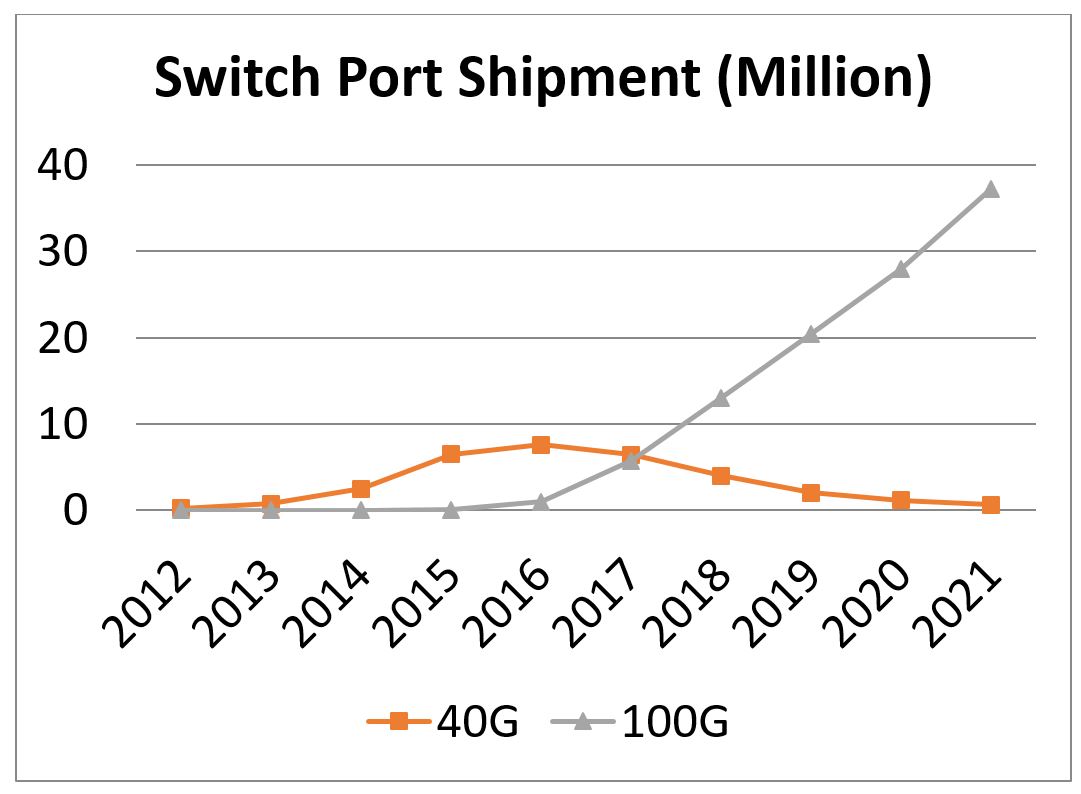
40G vs. 100G switch port shipments (Source: Dell’Oro 2017)
When considering system upgrades from 10G, it’s essential to understand that 40G will also be needed to support the legacy installed base with 10G ports; 40G/100G switch port configurability will certainly accelerate 100G adoption in the enterprise market.
In 2017, 100G Ethernet is already ubiquitous – it will be mainstream, not just in hyperscale cloud data centers. Next-wave 200G/400G Ethernet will soon hit the market; standards bodies have already initiated a study group for 800G and 1.6T Ethernet to support bandwidth requirements beyond 2020.
Wrapping up the road to 800G
We’re almost finished with our blog series covering the road to 800G Ethernet. Subscribe to our blog to follow this series, as well as receive our other content each week. As part of this blog series, we’ve covered the following topics:
- New pluggable form factors
- The evolution of high-speed interfaces and Ethernet switches
- Layer 0 copper connectivity
- Layer 0 fiber connectivity
The last blog in our series will be featured soon. It will discuss optical fiber cabling migration toward 100G, 200G, 400G and 800G Ethernet.
Our copper and fiber cabling and connectivity solutions are designed to help you prepare for 800G, which is the future of Ethernet. Learn more
作者简介
Qing Xu
光纤系统技术和应用经理
徐庆拥有 13 年的光通信和光子器件设计经验,不仅是光纤技术方面的专家,也是信号传输、数据中心趋势、光纤/铜连接和结构化布线方面的专家。 在百通任职期间,他密切关注并参与与光纤通信系统、数据中心技术和趋势相关的行业活动。