The jacket legend tells you where the cable can be installed, who manufactured it and even how easy it may be to handle (based on gauge size).
Have a question about the cable you’re using? Consult your cable jacket … it holds the answers!
As an example, let’s take a close-up look at the jacket legend printed on Belden’s REVConnect® Category 6A 10GXW12 Cable.
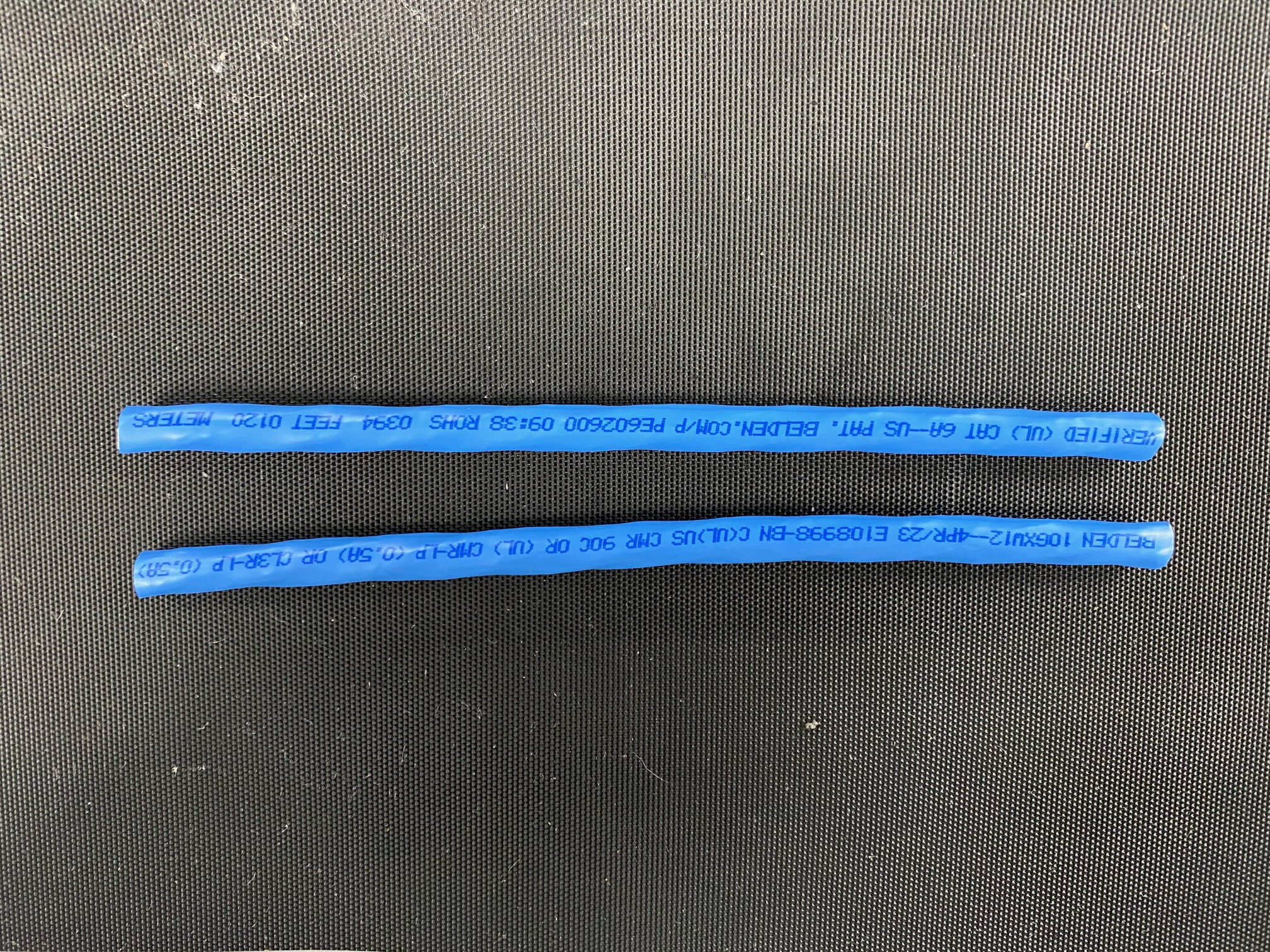
Here’s what you’ll find printed on the jacket …
Manufacturer name (Belden):
Even if the cable has been sitting in your warehouse for a while, one glance should tell you which company produced it. This information is helpful in case questions arise or you need to place an order.
Product name (10GXW12):
Knowing the name of the manufacturer is a step in the right direction … but having the name of the specific cable product you hold in your hands can make it easy to order more or look up additional information.
Number of pairs (4P):
Seeing “4PR,” “2PR,” etc. tells you the number of pairs in the cable.
Diameter/AWG (23):
The two-digit number listed next to the number of pairs provides the American wire gauge—or the cross-sectional area of a round wire (essentially the diameter). The larger the number, the smaller the cable’s overall diameter. In this case, a 23 AWG cable diameter is pretty small (0.25 in) so it’s easier to manage.
The 10GXW12 Cable, for example, is the smallest, lightest Category 6A cable available—and the easiest horizontal Category 6A solution to handle, install and route through plenum spaces.
UL reference number (E108998-BN):
This is the reference number for the UL filing number. This number is unique to each manufacturer and may vary for different designs. When combined with other information on the print string, it will lead to the UL Listings of the cable.
UL marking (C[UL]US):
“UL” is formerly known as “Underwriters Laboratories”—the global safety certification company. When those two letters appear on a cable, this indicates UL’s mark of approval for that product.
The “UL” mark applies to products designed and sold within the United States that are suitable for electrical environments.
The “cUL” mark applies to products designed and sold within Canada that are suitable for electrical environments. Cable printed only with “UL” isn’t appropriate for use in the Canadian market.
UL reference numbers should always be followed by the word “verified” to indicate that the standards body listed before it did, in fact, verify the cable.
Material class/fire rating (CMR-LP):
When “C” and “M” are seen together, this means the cable can be used in accordance with the National Electrical Code (NEC or NFPA 70).
“CM” indicates a general-purpose cable; fire code doesn’t place restrictions on cable types in these applications.
With this example, “CMR” tells you that this is a riser-rated cable—one designed to prevent fire from spreading from floor to floor.
You may also see “CMP” on your jacket legend (which indicates a plenum-rated cable that restricts flame spread to no more than 5 ft). These cables can be used in plenum spaces (like the area above a suspended ceiling).
The “LP” listed after “CMR” indicates that the cable is certified for large bundles in Power over Ethernet applications over 60W. The number listed right after (0.5A) indicates that it can support up to 100W of power delivery without exceeding listed temperature ratings. “LP” stands for “Limited Power,” which is a certification from UL.
Temperature rating (90C):
In this case, a temperature rating of 90 degrees C means the cable jacketing will maintain its fire rating properties in applications with ambient temperatures that reach this level. Beyond that, materials may start to degrade and impact cable performance.
Category (CAT 6A):
On a copper cable, you’ll see “CAT 5E,” “CAT 6,” “CAT 6A,” etc. This simply tells you what type of cable it is so you know what type of bandwidth to expect—and across how many meters.
RoHS:
Seeing this acronym indicates that the cable’s manufacturer followed the Restriction of Hazardous Substances (RoHS) guidelines, which originated in the European Union to restrict the use of hazardous materials found in electrical and electronic products.
Have questions about what’s printed on your cable jacket? Need help deciphering the legend? Give us a call, and we can walk you through it.
作者简介
Ron Tellas
Belden企业解决方案业务部高级解决方案架构师
Ron Tellas 是射频设计和电磁传播方面的主题专家,于 2016 年加入 Belden,帮助制定智能建筑技术和应用的路线图。 他现在利用这些经验将系统、设备和连接纳入网络解决方案。 Ron 代表 Belden 参加多个标准组织、国家电气规范委员会并担任 FMP 联盟的董事会成员。 他拥有电气工程硕士和学士学位、工商管理硕士学位,也是 17 项美国专利的发明人。 罗恩因其对电信行业的杰出和有影响力的贡献而自豪地荣获 2024 年 Harry J. Pfister 奖。