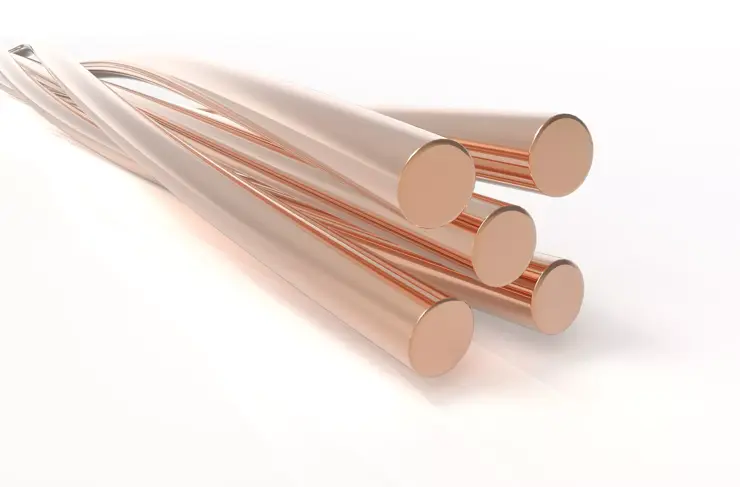
Next-generation 200G and 400G Ethernet interconnects will still be supported by copper and fiber connectivity. Here, we’re outlining the requirements that data centers will face, and explaining why layer 0 (cabling and connectivity infrastructure) is becoming increasingly critical in supporting ultra-high data rates.
Differential Twinaxial Cable and Direct Attach Copper Assemblies
Twinaxial (twinax) copper cable is constructed with differential copper pair with ~100Ω impedance, and a drain (ground) wire for differential high-speed signaling.
- In a typical one-lane direct attach copper (DAC) assembly (e.g. SFP+), two pairs of twinaxial cable are bundled together in the same jacket.
- In a four-lane DAC assembly (e.g. QSFP+), eight pairs of twinaxial cable are bundled together in the same jacket.
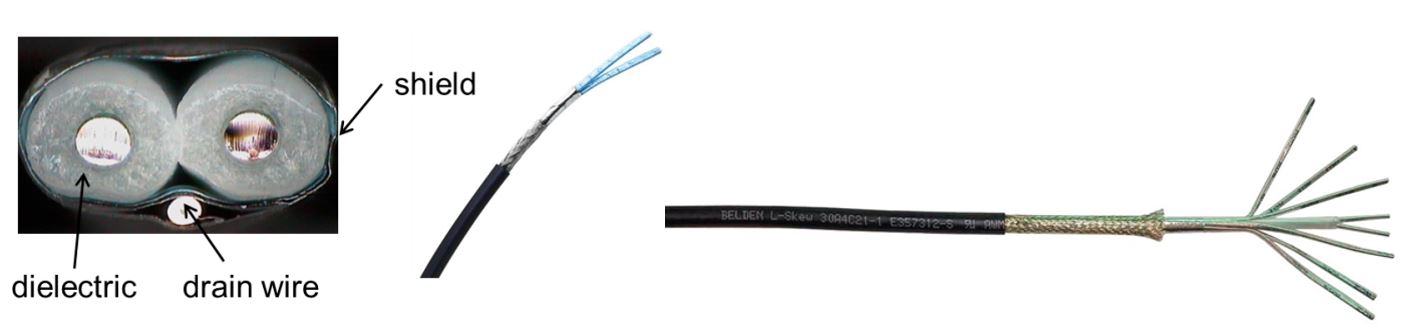
Twinaxial copper cable construction: one-lane DAC and four-lane DAC
Today, twinaxial-based passive DAC is the de facto intra-rack interconnect solution (server to ToR switch) for most cloud data centers, mainly thanks to its low cost and solid performance in short-reach applications.
- The main characteristic of merit – insertion loss of the differential twinaxial pair (SDD21) – is measured at the Nyquist frequency (half the signaling rate).
- The frequency range of interest (cable suck-out free range frequency) is typically 0.75 × signaling rate.

As data rates increase, however, the maximum reach of DAC shrinks. For each new generation, there is roughly 30% less reach as a result of much higher insertion loss at the Nyquist frequency.
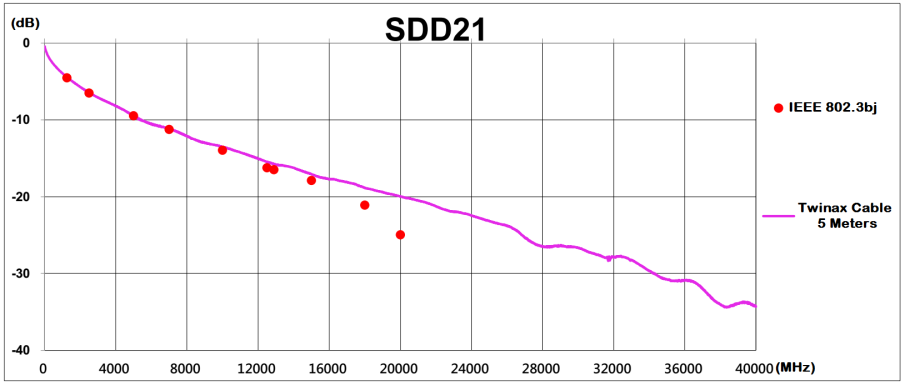
Belden high-speed twinaxial cable insertion loss (5 m for 25GBASE-CR and 50GBASE-CR)
Compared to simple NRZ (non-return to zero) modulation, however, PAM4 modulation allows data rates to double without replacing the DAC cable assembly – but it comes at a cost of reduced signal-to-noise ratio, requiring more complex digital signal processing at the host (active system).
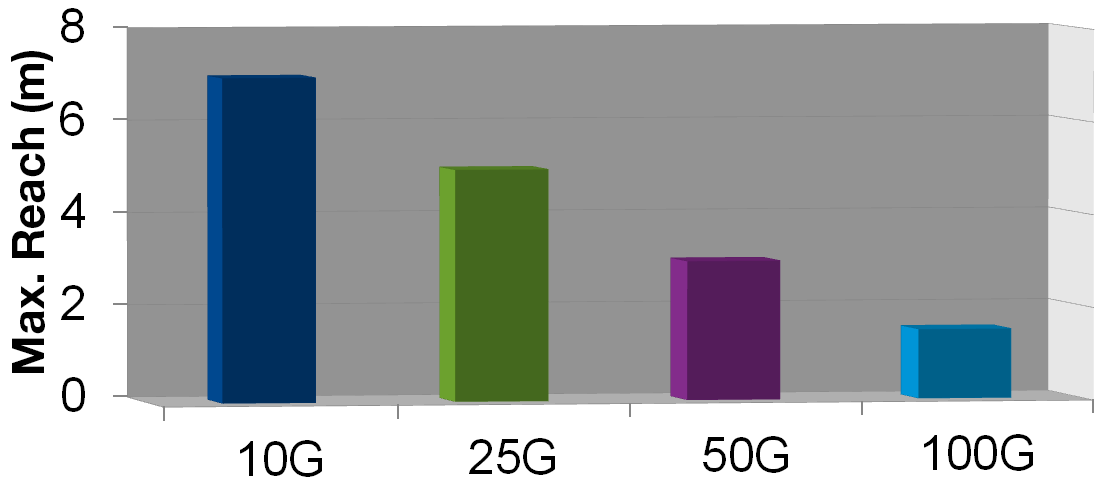
DAC maximum reach vs. transmission speed (per lane)
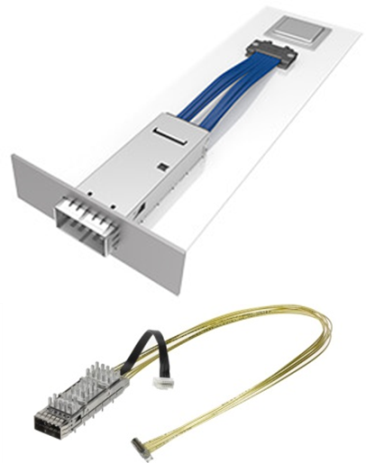
On-Board Copper Cable Assemblies
As data lane rates move from 25G to 50G PAM4, and then to 100G PAM4, the chip-to-module (OIF’s CEI-56G-VSR and OIF’s CEI-112G-VSR) interface becomes very challenging to meet maximum link loss requirements on the traditional backplane – even with premium low-loss PCB materials like MEGTRON 7.
Twinaxial cable, on the other hand, exhibits much lower loss over short distances (up to 35 cm for VSR [very short reach], 50 cm for MR [middle reach] and 1 m for LR [long reach]).
A new application using internal twinaxial cable to replace the lossy copper backplane can largely improve signal integrity for high data rates, such as 50G and 100G data transmission in a PAM4 format. Several high-speed cable assembly vendors have already developed workable solutions, raising industry interest in overcoming the signal integrity bottleneck.
As we look down the road to 800G, make sure to subscribe to our blog updates so you can follow along with us. We’ll be talking about:
- Layer 0 fiber connectivity
- The ubiquity of 100G Ethernet
- Optical fiber cabling migration toward 100G, 200G, 400G and 800G Ethernet
Our 800G Ethernet blog series has already covered:
- 100G to 800G for faster, cheaper Ethernet
- New pluggable form-factors
- The evolution of high-speed interfaces and Ethernet switches
Traditional PCB vs. twinaxial on-board copper assembly
Belden’s end-to-end copper and fiber cabling and connectivity will help you prepare for 800G Ethernet – and every stop in between. Learn more here.
作者简介
Qing Xu
光纤系统技术和应用经理
徐庆拥有 13 年的光通信和光子器件设计经验,不仅是光纤技术方面的专家,也是信号传输、数据中心趋势、光纤/铜连接和结构化布线方面的专家。 在百通任职期间,他密切关注并参与与光纤通信系统、数据中心技术和趋势相关的行业活动。