
Regular Fusion Splicing
The traditional approach to fusion splicing involves fiber pigtails (a single, short, tight-buffered optical fiber that has an optical connector pre-installed on one end). The exposed fiber end of the pigtail is stripped back and then fusion spliced to a single fiber of a multi-fiber trunk.
Mass Fusion Splicing
Instead of fusing one fiber at a time, mass fusion splicing can fuse up to all 12 fibers in one ribbon at once. Many of today’s cables with high fiber count involve subunits of 12 fibers each that can be quickly ribbonized. Splicing those fibers individually is very time consuming; mass fusion splicers splice entire ribbons simultaneously.
Time - And Cost - Savings
Mass fusion splicing may involve a slight increase in tooling costs, but can drastically reduce the amount of labor time spent on termination (by up to 75%) – which more than makes up for it. (Recent price drops have now made mass fusion splicers even more affordable.) With this increase in throughput, a typical contractor can turn jobs over much faster and bid jobs with more aggressive timelines.
Mass fusion splicing also allows for potential material savings. It enables migration from common indoor distribution cable with 900um fiber to smaller mini-distribution cable with 250um fiber, which is more cost effective.
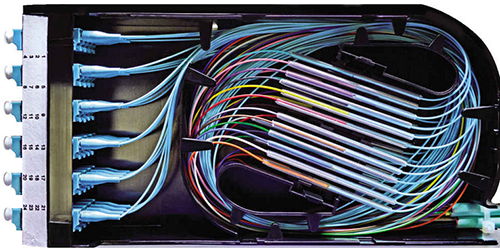
Belden offers a new way to store splice sleeves and manage slack in splicing applications. By eliminating bulky splice trays and housings, the FX UHD Splice Cassette integrates the connector, splice-holder and slack management into a compact, easily managed cassette format. Any shrink tube can be used inside the same cassette to make your job easier by ensuring compatibility – no matter the type of fusion splicing. Belden’s traditional pigtail and mass fusion pigtail kits provide whatever type of fusion option your project requires.
Learn More!
作者简介
Dwayne Crawford
全球产品线管理副总裁
Dwayne Crawford 在数据通信行业拥有 20 多年的经验。 他曾在多个国际标准委员会任职,致力于推进用于实时图像处理和利用高性能计算平台的高性能/低延迟协议(如 IEEE-1394、GigE Vision 和 CameraLink)。