
A vital function that is often unaccounted for in initial network architectures is built-in redundancy, the capability of the network to quickly reroute traffic in case of a failure at a particular point—fail-safes that help ensure uninterrupted uptime and optimal productivity. Unfortunately, many operations learn the hard way because they don’t account for redundancy. Operations often run in tough environments that can damage equipment and cabling. Without a contingency option, data flow is often completely stopped until maintenance teams can be deployed.
Fortunately, with today’s technologies, there are many options for building redundancy into networks, or readily retrofit existing networks as the case may be. This redundancy ensures that if one route goes down, another immediately takes its place. Belden and its portfolio of brands, for example, provide a complete series of products that can help protect every level of devices—from the network infrastructure backbone to the remote sensors at each wellhead. Systems are ruggedized and designed to modularly integrate together and include components such as Belden industrial Ethernet cabling, Hirschmann backbone and field switches, Hirschmann/Tofino Security Appliances and Tripwire Cybersecurity Software.
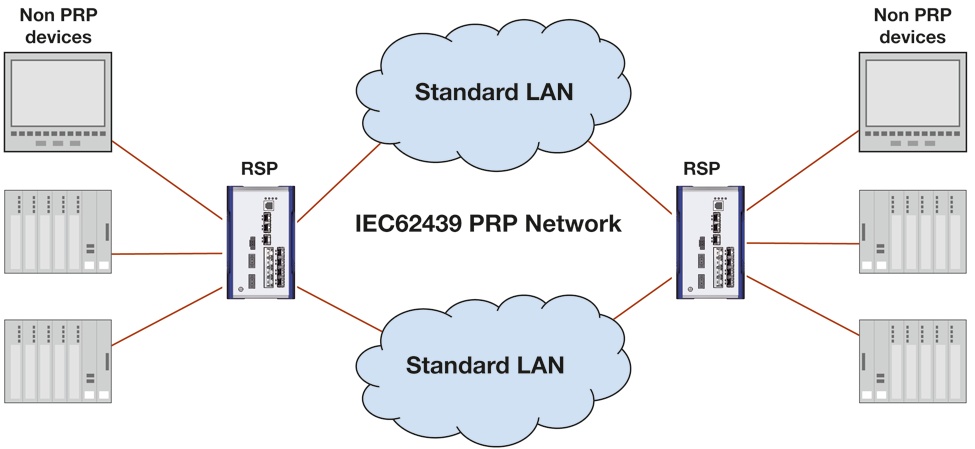
There are many kinds of ring and subring topologies to select from as well as both wired and wireless solutions to protect everything from network infrastructure to vulnerable field devices, in the Media Redundancy Protocol (MRP) and Parallel Redundancy Protocol (PRP). In fact, Belden’s Hirschmann group is well known for developing both of these common protocols and later made them open standards, ensuring even more choices for operators.
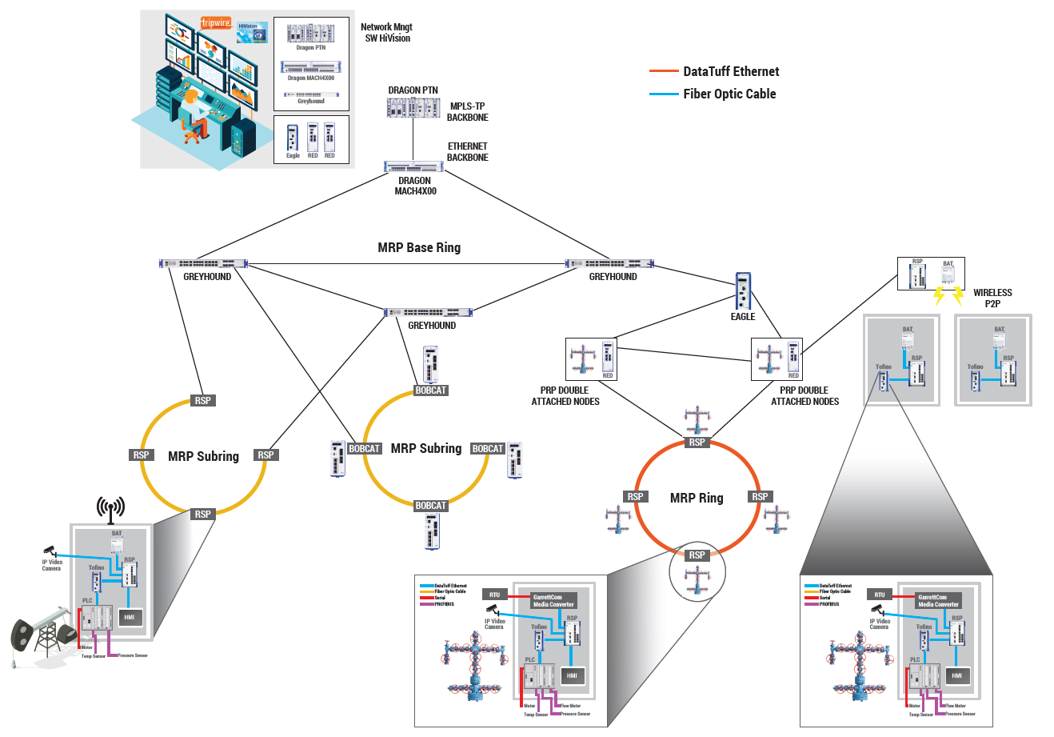
Many of these choices are illustrated in the schematic below. The detailed Industrial Ethernet network depicted is highly robust and secure, with multiple layers of redundancy on both the cable and hardware levels. In addition, there are strategically placed security appliances ensuring that data flows only where it is desired and that only proper personnel have access to it.
Overall, the schematic suggests many possibilities to “mix and match.” We are happy to talk through this to help you decide what concepts might be best for your operation. The key takeaway for now is that there are many choices for redundancy, and an option is out there that best meets your specific needs.
Network redundancy solutions apply to other oil and gas challenges—and other industries too
The retrofitting of network redundancy is a huge issue for wellhead monitoring operations today, but it is by no means the only area in the oil and gas industry where redundancy can be beneficial. Two we hear about often are pump station monitoring, where pipeline pressure and flow data is transmitted to and from central monitoring areas, and real-time monitoring at refineries for issues such as gas leaks. The illustrated redundancy technologies can be readily applied in these applications as well, helping achieve greater safety and reliability and avoiding costly network interruptions.
The examples in the schematic can also readily apply to applications in other industries. For example, mining, power utilities, manufacturing and wastewater are all industries where retrofitting redundancy is boosting uptime and productivity in network applications of many kinds.
Do you have adequate redundancy in place to help your operation avoid downtime and maintain the integrity of your data? We can help you take a closer look and weigh your options. Contact us any time for a no-obligation discussion. We want to share what we know with people who could benefit from it.
作者简介
戴维·戴茨
全球客户总监
David 于 2013 年加入 Belden,担任销售工程师,主要负责定位和指定 Belden 工业连接、网络和网络安全产品。 过去 6 年,他在 Belden 担任过多个职务,包括专注于过程自动化行业的美洲战略营销经理,目前担任美国东部和加拿大的销售总监。 David 在协助客户利用最具创新性的产品、技术和行业最佳实践设计自动化和控制网络方面拥有丰富的经验。 他拥有宾夕法尼亚州克莱里昂大学市场营销学士学位和弗吉尼亚联邦大学工商管理硕士学位。