
What are Pluggable Modules?
Developed to support telecom and data communications applications, edge-mount pluggable cages on network equipment provide standard interfaces so that pluggable modules can be inserted and adapted. Pluggable modules can be active (consume power) or passive (do not consume power), and the transmission media can be copper or optical fiber, following industrial networking standards (e.g. Ethernet, Fibre Channel, InfiniBand).
10G SFP+ (1 electrical lane) and 40G QSFP+ (6 parallel electrical lanes) pluggable modules have been a great market success for years. The same mechanical form factors (SFP28 and 100G QSFP28) have been adopted to support 25G single lane and 4× 25G parallel lanes.
Different physical media can support cost-effective, optimized interconnects for different reaches and data center architecture:
- Twinax direct-attached copper (-CRx) for intra-rack interconnects, up to 5 m reach
- Multimode fiber (-SRx) interconnects, up to a few hundred meters reach
- Singlemode fiber (-PSM, -DRx, -FRx, -LRx) interconnects, up to 10 km reach
Note: 'x' represents the number of electrical parallel lanes in the PMD (physical media dependent) sublayer.
New Pluggable Form-Factors & Faster Ethernet Speeds
At 200G and 400G, however, the data transmission technology development (NRZ modulation format) and conventional one-lane SFP and four-lane QSFP form factors can no longer keep pace with imminently high bandwidth requirements.
PAM4 modulation format has been adopted for 50G (and beyond) serial electrical and optical links to combat serious signal integrity degradation at higher frequencies.
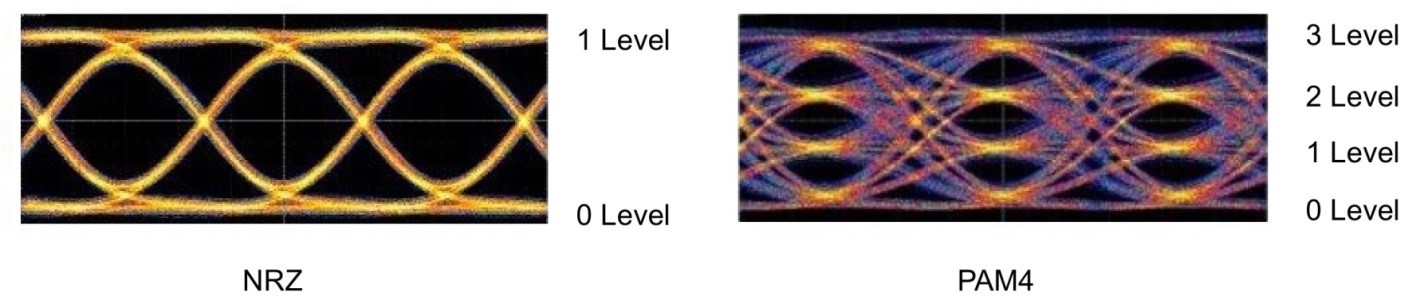
New eight-lane form factors (QSFP-DD and OSFP) have been invented to support 8× 25G and 8× 50G PAM4 signaling to support 200G and 400G ports.
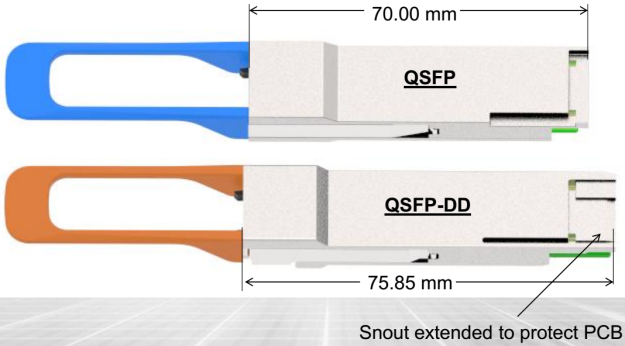
QSFP-DD supports the same faceplate density and is backward compatible with QSFP modules, with a maximum power rating of 14W.
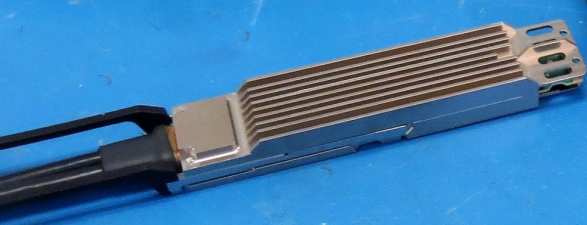
OSFP supports eight-lane parallel data transmission with efficient heat dissipation for a wide range of interconnect applications, including metro data center interconnects, with a maximum power rating of 16W.
Smaller-sized, higher-density pluggable form-factors, such as µQSFP and SFP-DD, have been invented to increase switch faceplate I/O density. Cost-optimized form-factors, such as RCx, are available to simplify the pluggable design for high-volume, intra-rack passive copper connectivity.
A new form factor—RCx (RC1, RC2, RC4)—has been introduced as a low-cost passive copper connector and cable system, specifically designed for intra-rack connectivity (<3 m) in 25G, 50G and 100G Ethernet.
This new design has several advantages over the most popular SFP and QSFP pluggables for large-volume, intra-rack, server-to-switch interconnects:
- It supports simple, low-cost, low-power, passive direct-attach copper (DAC) only, without power, re-timers, EEPROMs or I2C interfaces.
- It requires much less board space for the pluggable cage, simplifying the switch & network adaptor design & cost
- No need for additional breakout cable design
Watch out for future blog posts on related topics including:
- The evolution of high-speed interface & Ethernet switches
- Layer 0 copper connectivity
- Layer 0 fiber connectivity
- The ubiquity of 100G Ethernet
- Optical fiber cabling migration toward 100G, 200G, 400G & 800G Ethernet
作者简介
Qing Xu
光纤系统技术和应用经理
徐庆拥有 13 年的光通信和光子器件设计经验,不仅是光纤技术方面的专家,也是信号传输、数据中心趋势、光纤/铜连接和结构化布线方面的专家。 在百通任职期间,他密切关注并参与与光纤通信系统、数据中心技术和趋势相关的行业活动。