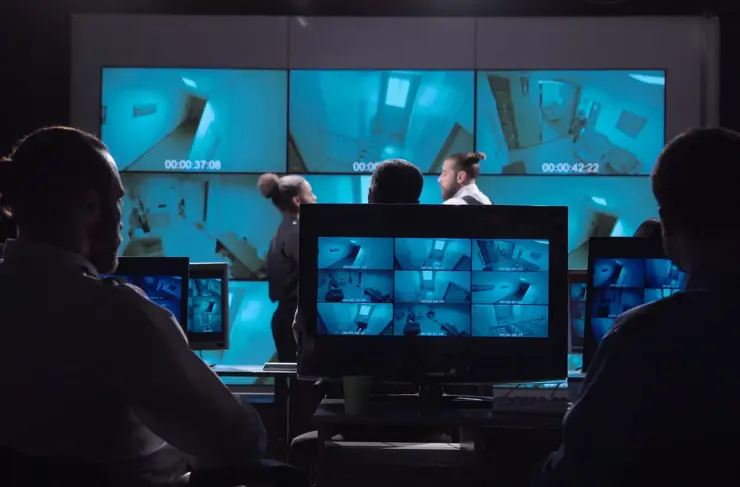
Today, that same network still supports those systems – and many more. Devices like wireless access points, access control systems, video surveillance, digital signage, LED lighting and nurse call systems are all coming together (“converging”) onto enterprise networks.
And along with this increase of devices come a few more demands:
- Many of these systems call for longer reach (the devices will be up to 100 m away from a switch)
- Many of these systems call for higher Power over Ethernet (PoE) levels of up to 100W
- Because of their importance to everyday operations, many of these systems will call for 100% uptime and network connectivity for data collection and sharing
Device reliability is one part of that equation, but there’s another important component: your cabling and connectivity infrastructure (what we like to call “layer 0”). Your network must be able to manage multiple systems that require higher performance, more bandwidth, faster speeds and low latency. For these reasons, industry standards that previously recommended Category 6A cabling only for data centers now recommend it for most LAN installations as well. Without it, your cabling system could become a productivity and revenue bottleneck.
In addition to all of these devices joining networks, new technology and applications are also driving the need for Category 6A cabling. These include:
- Next-generation wireless, including Wi-Fi 6 (IEEE 802.11ax). It is set to alleviate the frustration associated with network overuse. It offers improved speed capabilities and the ability for many people to be on a network at the same time without speed or connectivity problems.
- In-building cellular networks, which take the form of a distributed antenna system (DAS) or Wi-Fi system. These systems help bring cellular signals into buildings to ensure connectivity – despite factors that negatively impact propagation, such as glass, wood and cement.
- Increased data sharing and transferring, along with the need to quickly transfer large files. Medical imaging, high-definition streaming video, high-end graphics and surveillance video are all good examples.
- 100W PoE, which takes advantage of all four pairs in a 4-pair cable, spreading current flow out among them. Power is transmitted along with data and is compatible with data rates of up to 10GBASE-T. It can also deliver higher power levels to devices with a smaller temperature rise inside a cable bundle, avoiding poor transmission performance.
- AV over IP signal transmission, with technologies like HDBaseT, SDVoE, Dante AV, AVB (Audio Video Bridging) and others with large bandwidth requirements.
In each one of these situations, the best (and possibly only) viable solution to support these emerging technologies and applications is Category 6A cabling.
Now, in addition to Category 6A 10GXS Cables, there’s a new Category 6A option specifically for smart building applications. Belden’s 10GXW Cables allows you to easily upgrade performance levels for smart building applications like in-building wireless. They offer the smallest Category 6A cable diameter on the market, which also makes the cable light and easier to deploy.
作者简介
Ron Tellas
Belden企业解决方案业务部高级解决方案架构师
Ron Tellas 是射频设计和电磁传播方面的主题专家,于 2016 年加入 Belden,帮助制定智能建筑技术和应用的路线图。 他现在利用这些经验将系统、设备和连接纳入网络解决方案。 Ron 代表 Belden 参加多个标准组织、国家电气规范委员会并担任 FMP 联盟的董事会成员。 他拥有电气工程硕士和学士学位、工商管理硕士学位,也是 17 项美国专利的发明人。 罗恩因其对电信行业的杰出和有影响力的贡献而自豪地荣获 2024 年 Harry J. Pfister 奖。