
Related Tags
Higher-frequency bands, such as spectrum in the microwave range, excel at transmitting high-speed data, but they don’t carry these signals very far and don’t penetrate buildings easily. Low-frequency bands, such as spectrum in the range of 700 MHz to 800 MHz, excel at supporting wide coverage areas. While they can penetrate buildings for connectivity indoors, they don’t support high bandwidth or fast speeds.
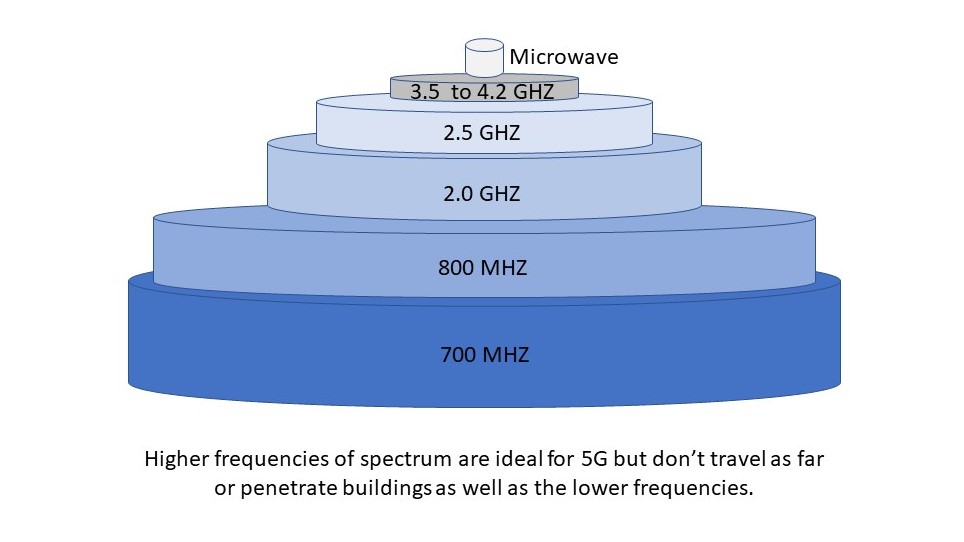
It’s important to note that spectrum is a finite resource. When 5G first launched in the United States, C-band spectrum wasn’t available; instead, it was assigned to large satellites. As those types of TV services fell by the wayside, there was massive demand to reallocate the frequencies for other purposes—like 5G.
As a result, the C-band range of spectrum recently became commercially available through a Federal Communications Commission (FCC) auction. To keep up with increasing speed and bandwidth consumption, mobile carriers like Verizon, AT&T, T-Mobile and US Cellular were top bidders to acquire these additional frequencies. It’s officially the largest section of mid-band spectrum the FCC has ever released and will be fully utilized across the country within one to three years.
So how will it be used? Picture yourself at Raymond James Stadium in Tampa, FL. On your way to the concession stand to grab a frozen lemonade, you walk by a video mirror. You stop and press a button to see an image of yourself wearing a Tampa Bay Buccaneers jersey, which is available for purchase online or in the Team Store. The mirror shows you exactly how the jersey will fit based on accurate dimensions. This augmented-reality technology already exists. Because it requires low latency to support back-and-forth data transfer, we’re just waiting on 5G to make it a reality.
Do You Have the Infrastructure to Support C-Band and 5G?
It’s very likely that most large entertainment and sports venues, high-rise office buildings and manufacturing facilities already have infrastructure to enhance indoor mobile coverage. Some buildings may amplify RF signals from a nearby cell tower while others may generate connectivity from systems installed inside the building itself. As more 5G devices are put into play, however, many of these buildings may need to update their in-building wireless infrastructure and distributed antenna systems to meet new density and capacity requirements.
As C-band rolls out over the next few years, now’s the time to make sure your in-building wireless infrastructure is ready. If the infrastructure is outdated, or perhaps relying on an amplified coverage from a nearby tower, it might be time to consider upgrading. Businesses are installing dense, fiber-based systems to ensure scalability and flexibility so they can take advantage of additional spectrum releases and technological advancements as they occur.
Updated cabling and connectivity not only ensure your ability to support speed and capacity through the use of 5G and C-band, but also provide low latency for emerging technologies like virtual and augmented reality and artificial intelligence. Think of the networks that will empower self-driving cars, remote surgeries and remote forklift operations, for example.
We’ve only just begun to scratch the surface of what 5G will offer—and C-band will help us achieve the right balance between coverage and bandwidth to benefit many verticals and applications.
Over the last 120 years, Belden has played a key role in leading customers through technological advancements across all industries. We’re excited to continue these partnerships and provide guidance through 5G … and beyond.
We’ve developed fiber and Category 6A solutions that help create a robust, reliable and high-performance infrastructure—without compromising on performance or ease of use. Remember: The technology you deploy can only be as good as the cables and connectivity that support it.
作者简介
Steve Carroll
5G 基础设施服务提供商全球客户总监
史蒂夫·卡罗尔 (Steve Carroll) 在无线、有线和物联网技术及基础设施方面拥有二十多年的经验,于 2021 年初加入 Belden 团队,担任服务提供商和 5G 基础设施全球客户总监。他专注于帮助客户构建可扩展的业务解决方案,以提高生产力和沟通能力,同时最大限度地降低风险。