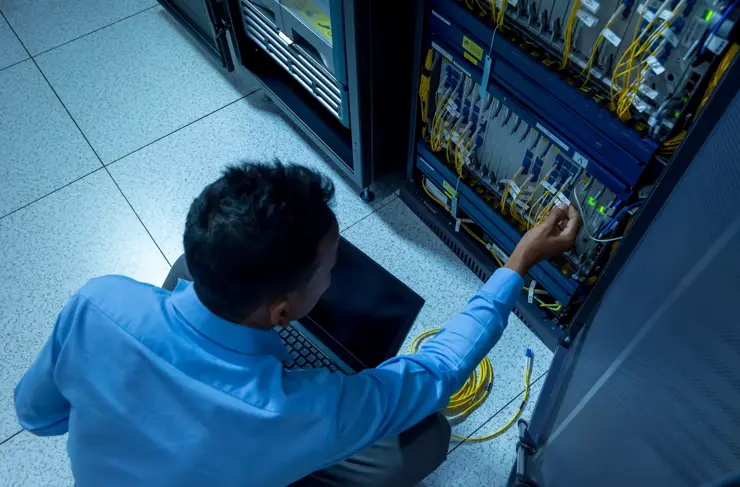
When connectors or fibers aren’t properly aligned, fiber polarity is interrupted. The transmitted signal misses the intended receiving fiber. For instance, this misalignment can occur when:
- The wrong type of patch cord is used
- A connector is flipped
- A connector is plugged into the wrong port
When these kinds of mistakes happen, the transmit signal can’t connect to the corresponding receive port. This means the signal is not transferred between fiber ends, creating signal degradation and poor network performance.
What drawing tools lack when it comes to fiber polarity
To visualize how signals flow through a fiber system and ensure alignment between transmit and receive fibers, many engineers, designers and installers opt to draw or map fiber polarity.
This practice also documents polarity so it can be referenced during moves, adds and changes or other maintenance or upgrade projects.
For example, when new equipment is added to a rack, fibers need to connect to the patch panel. If there is no polarity map—or if it isn’t referenced—then a technician may accidentally flip a connector, which connects the transmit signal to a transmit port instead of a receive port.
While drawing tools and graphics software can simplify this visualization process and help teams create polarity maps, these tools can also introduce risks. They make it too easy to mistakenly alter or misrepresent the intended configuration of the fiber system and create fiber polarity problems.
Why fiber polarity documentation matters so much right now
Why is it so important to improve the way fiber polarity is drawn? Because, as needs evolve and require new technology, fiber systems are becoming more complex. They must be able to support:
- Data centers that process information for artificial intelligence and machine learning
- 5G networks that demand massive data capacity
- Cloud computing environments that rely on high levels of data traffic
- Edge computing environments that demand low-latency performance
- Virtual and augmented reality platforms that require high speeds and no disruption
- Healthcare technology, like telemedicine, which involves reliable communication
Massive amounts of data flow through these applications, and it needs the ultra-low latency and high reliability that fiber can provide. As more systems, devices and users are added to the network, fiber systems must also be able to scale and accommodate higher fiber counts, which can further complicate network design.
If your team documents fiber configurations using traditional polarity drawing practices, your drawings will become just as complex as your systems. And they’ll be difficult to follow.
改变行业映射光纤极性的方式。 我们不会使用难以理解的图纸,而是将重点放在创建视觉符号上,以直观地表示每个组件的外观并描述每个组件的功能。
例如:
- 适配器符号将用正方形表示
- 线缆组件将用圆圈表示
- 形状内的信息代表什么’电缆或适配器内部发生的情况
这种简化的过程可通过以下方式降低极性映射的复杂性,提高准确性,并简化培训:
- 对符号进行标准化,以实现跨文档和团队的一致性
- 在每个符号中表示绞线股数、引脚、长度、损耗曲线、零件编号等属性
- 减少潜在的误解,使极性在视觉上更直观易懂
- 使复制和更新极性图变得快速简单
- 无需依赖颜色和颜色编码来识别光纤或保持极性
- 消除了由绘图工具或软件创建的自由形式修改(例如意外移动元素或调整元素大小)
了解有关光纤极性的更多信息
如果您想了解有关光纤极性和映射重要性的更多信息,请观看我们光纤极性系列的最新网络研讨会。
我们将解释这些即将发生的变化,引导您了解新符号,并描述这些变化对光纤项目的意义。
观看网络研讨会。
相关链接:
作者简介
Henry Franc
现场应用工程师
Henry Franc 专注于数据中心的设计、规划和建设,是各垂直领域大型或复杂项目的值得信赖的顾问,负责评估客户的业务需求并找到满足这些需求的最佳技术方案。 他还被业界同仁推选为 TR42 电信布线系统工程委员会副主席。