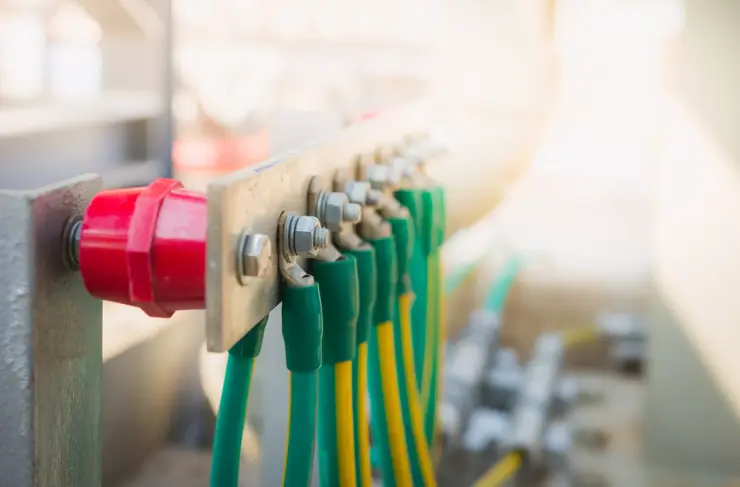
The terms “grounding” and “bonding” are often confused or misused (e.g., connecting a lug or piece of metal to a data center rack is often thought of as “grounding” the system however, that process actually “bonds” the system).
Grounding vs Bonding
Simplistically put, grounding (typically handled by electricians) involves creating an electrical connection to earth ground—essentially, a copper pole driven into the ground enabling electrical utilities to connect to it.
Bonding involves connecting to that grounding system and equalizes the ground potential of equipment eliminating static discharge between devices.
In a successful grounding and bonding system, electromagnetic interference noise is carried to ground along a shield to protect data from being impacted by noise during transmission. Any metal component of the networking or data center infrastructure should be bonded to the grounding system.
Determining who is responsible for installing a grounding and bonding system can be tricky. Some believe integrators and other cabling installers have a responsibility to recognize and understand grounding and bonding systems while others believe the responsibility lies elsewhere (as bonding is done to a grounding system the low-voltage installer isn’t responsible for).
We believe it's important for all involved in cabling and connectivity to understand grounding and bonding however, professionals in the telecommunications industry should primarily be focused on ensuring proper bonding.
How Bonding Works
The following summary covers a bonding system in a multi-level building.
- The primary bonding busbar (PBB) is located on the lowest level of a building & is attached to the grounding system (installed by the electrician).
- From the PBB runs a telecommunications bonding backbone (TBB), essentially a thick-diameter copper wire running up through each floor of the building to reduce variation between telecom systems on different floors.
- Each floor of the building has a secondary bonding busbar (SBB) which runs continuously to connect all SBBs to the PBB on the lowest level.
- The cable shielding system attaches to the SBBs & TBBs in the grounding system.
- If the building has equipment running on each side, the same scenario holds true for the other side of the building.
ANSI/TIA-607-C (Generic Telecommunications Bonding and Grounding for Customer Premises) encourages planning, design and installation of telecommunications grounding and bonding systems in new buildings, renovations or retrofits. Belden bonds cable shields to ensure proper system performance. Additionally, the third prong on all Belden equipment is considered a ground (in scenarios where it has a good path to earth ground).
作者简介
Ron Tellas
Belden企业解决方案业务部高级解决方案架构师
Ron Tellas 是射频设计和电磁传播方面的主题专家,于 2016 年加入 Belden,帮助制定智能建筑技术和应用的路线图。 他现在利用这些经验将系统、设备和连接纳入网络解决方案。 Ron 代表 Belden 参加多个标准组织、国家电气规范委员会并担任 FMP 联盟的董事会成员。 他拥有电气工程硕士和学士学位、工商管理硕士学位,也是 17 项美国专利的发明人。 罗恩因其对电信行业的杰出和有影响力的贡献而自豪地荣获 2024 年 Harry J. Pfister 奖。