
As a result, two pieces of fiber cable will need to be joined together to create one. This, of course, requires connecting and/or cutting cables in the field.
When it comes to connecting cables (ora “splicing”), you’ve got two options to choose between: mechanical or fusion splicing. Both have their own sets of benefits and drawbacks.
Historically, fusion splicing has been considered a more expensive option as compared to mechanical splicing. Recently, however, fusion splicing is becoming more popular because of its ability to ensure excellent connections while reducing rework and lowering installation costs (especially with projects involving lots of splices).
While mechanical splicing involves manual physical alignment of fibers using an alignment device and gel, fusion splicing is an automated process that relies less on the skills and expertise of technicians and installers. While using a fusion splicer does require some initial training, installers pick up on the process quickly and are soon ready to splice in the field after some simple preparation work.
To complete a fusion splice, you need the right equipment, including a fusion splicer (which permanently melts/fuses two fibers together at their end faces to create one fiber).
Many manufacturers offer proprietary fusion splicers, meaning that the splicer can only be used with that specific manufacturer’s connectors. When you purchase a splicer, it typically comes with a set of fiber holders (left and right) to help optical fibers load correctly. Those fiber holders are likely designed to be used only with that manufacturer’s connectors and splicer.
As the quality of fiber optic cables continues to increase, reliability and performance of splice connections are becoming less about the type and quality of the fusion splicer you use and more about cable and connector quality. Even a lower-cost splicer can create quality fiber splices if the instructions are followed, the equipment is used and maintained correctly, and high-performance cable and connectivity components are deployed.
When you’re searching for a fusion splicer that meets your project needs and budget, there is one feature you may want to consider: interchangeable fiber holders.
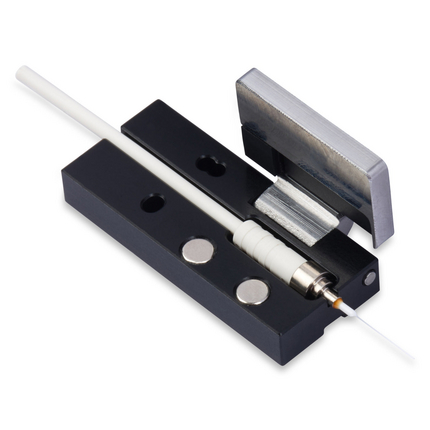
Although this feature may be hard to find, interchangeable fiber holders give you the flexibility to use whichever splicer you choose so you can work with the components you prefer (and what you already have)–or switch connectors when needed without investing in a different splicer.
An interchangeable fiber holder is designed to sit properly in different splicers and work with different connector footprints (SC and LC, for example). Simply remove the existing fiber holders, slide in the interchangeable holder and you’re ready to go. There’s no longer a need to worry about matching connectors with specific holders and splicers–or keeping multiple types of splicers or fiber holders around to accommodate different scenarios.
Belden offers interchangeable fiber holders that work with several different connector types and accommodate different splicer manufacturers – not just our own. Learn more here. The fiber holder is designed to sit properly in different splicers and work with different connector footprints (e.g., SC and LC). Simply remove the existing fiber holders, slide in the interchangeable holder and you’re ready to go. There’s no longer a need to worry about matching connectors with specific holders and splicers– or keeping multiple types of splicers or fiber holders around to accommodate different scenarios.
作者简介
Ana Cruz
产品开发经理
作为光纤连接产品开发经理,Ana Cruz 于 2012 年加入 Belden,在通信、交通和工业环境中使用光纤电缆和连接器技术方面拥有近二十年的经验。 如今,她帮助管理 Belden 的光纤产品系列,寻找新的光纤解决方案的机会并帮助评估关键产品性能指标。 她还为客户提供宝贵的技术援助和专业知识。