
Before you decide for sure that fiber is the right way to go for your project, there’s another decision to make: Do you need singlemode or multimode fiber?
One isn’t superior to the other – each has its own place within the right applications. But knowing the differences can prevent you from investing in the wrong type of cable or using a cable that isn’t compatible with your optical fiber devices, which can negatively impact the signal.
Here, we’ll walk you through the differences when comparing singlemode vs. multimode fiber to help you make the best choice.
Singlemode vs. Multimode Fiber: Construction Differences
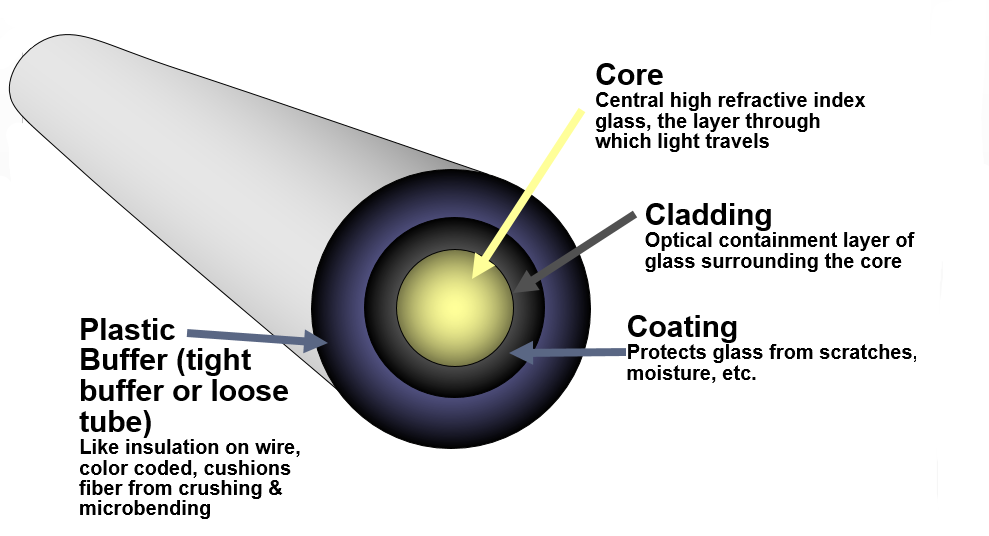
When comparing how singlemode and multimode fiber are manufactured, there’s one big differentiator: Singlemode fiber’s core size is smaller and carries light directly down the fiber (it only allows the fundamental mode of light to transmit down the fiber). As a result, light reflection created during light transmission decreases, lowering attenuation and allowing the signal to successfully travel over longer distances.
Multimode’s core size is five to six times larger in diameter than singlemode, which allows for much greater light-gathering capacity and facilitates the use of cheaper electro-optic devices. Multiple modes or light paths travel down the fiber at once, which has traditionally limited transmission distance and bandwidth – but this is being considered as a modulation format for “few-mode” fiber, which we aren’t discussing here.
Singlemode vs. Multimode Fiber: Application Differences
Because multiple modes/light paths travel down a multimode fiber cable, it only offers high bandwidth over a short distance.
When run over longer distances, modal dispersion (distortion) becomes an issue. This is typically expressed in a fiber’s “effective modal bandwidth” characteristic, which is an inverse relation between fiber bandwidth and reach distance. As signaling bandwidth increases, the reach distance decreases – and vice versa – due to the modal dispersion effect.
In singlemode fiber, all light from a pulse travels at about the same speed and arrives at roughly the same time, eliminating the effects of modal dispersion found in multimode fiber. This supports higher bandwidth levels with less signal loss over longer distances. It’s ideal for long-haul signal transmission applications, such as across or between campuses, undersea or in remote offices. There are essentially no distance limitations.
Singlemode vs. Multimode Fiber: Cost Differences
Currently, singlemode fiber is typically less expensive than multimode fiber, but it’s important to keep other price factors in mind as well.
Most fiber systems use transceivers, which combine a transmitter and receiver into a single module using fiber optic technology to send and receive data over an optical network. Right now, the price of multimode transceivers is two or three times lower than the price of singlemode transceivers.
As transceiver prices come down, however, singlemode is starting to be used more often in shorter-distance applications as a cost-effective choice.
Singlemode vs. Multimode Fiber: Cable Types
When you see mentions of OM1, OM2, OM3, OM4 and OM5, you know you’re talking multimode fiber. But it’s not quite as simple with singlemode fiber. Today’s types of singlemode fiber include:
- Standard singlemode fiber (G.652
- Cutoff shifted fiber (G.654)
- Low water peak fiber (G.652)
- Dispersion shifted fiber (G.653)
- Non-zero dispersion shifted fiber (G.655)
- Bend-insensitive fiber (G.657)
Each type of singlemode fiber features its own characteristics. Depending on operating wavelengths, distance and transmission link architecture (which may include various amplification methods), there are different considerations to take into account before making a selection.
Preparing for Your Next Project
As fiber electronics technology changes and improves – including modulators, lasers, PHYs, transceivers, etc., which make up a complete fiber cable system – singlemode and multimode fiber cables must improve as well.
To ensure you get exactly what you need, we recommend working with a systems architect that can help you design a fiber system based on length budgets, number of network clients and where your data sources will be hosted.
Have questions about your next fiber project? Send us a note. We’ll provide the answers you need!
作者简介
Jim Zimnicki
光纤高级产品开发工程师
Jim Zimnicki 在 Belden 工作了七年多,从事电缆制造、工程和产品开发工作。 在 Belden 实习后,他于 2017 年 8 月全职加入团队。作为前产品开发工程师和高级产品开发工程师,Jim 负责监督设计以满足客户和新业务标准,评估测试数据以确保符合标准,并支持 Belden 制造试验。 他拥有代顿大学电气工程学士学位和光电学理学硕士学位。