Here’s a Great Analogy: How Ridiculous Would It Be for a Rock Band to Practice Inside a Library?
Not only would that be disruptive, it would completely prohibit regular functions. The vibration and noise inside the library would be unbearable for others working inside that space. In the case of your industrial environment, the primary result of both noise and vibration is signal loss.
This is of particular importance with Ethernet cabling due to the fact that a higher bit error rate can arise, which is detrimental in the communication network required for uptime. The impact of signal loss is more severe for higher-bandwidth applications and at higher data rates.
First, let’s break this terminology down:
- Vibration: Continuous or rapid movement. In the case of your connectors, this movement can jar connections, ultimately loosening or even completely disconnecting them – which creates a loss in signal transmission.
-
Noise: Unwanted disturbance in an electrical signal, also known as interference. In the case of your cables, noise can occur when the individual layers experience vibration from an outside source (such as another machine or cable) and move relative to each other. This movement creates noise and results in crosstalk.
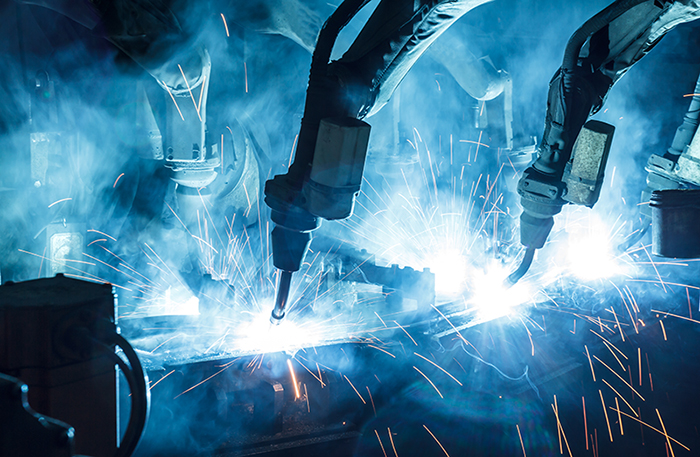
- Crosstalk: Unwanted transfer of signals between communication channels. In an industrial environment, there’s a lot going on at all times. Think of all the activities that happen on the plant floor at the same time – people and machines are constantly working, cutting, welding, driving and so on. Because of this, you have a lot more noise/frequencies and vibration than a typical environment. This additional noise interferes with the frequency of your connectors, switches, sensors and other devices, ultimately impacting their performance.
What Really Happens to Connectors When Exposed to Noise and Vibration?
The short answer is, if your connectors are not meant to withstand the environment they are in, they don’t work. At least, they don’t work the way you want them to. Products are manufactured to perform specific functions in specific environments.
Connectors in industrial settings need to incorporate adequate shielding protection to prevent the impact of noise. In terms of vibration, the connector needs to be designed to ensure vibration does not compromise the physical integrity of the connection. “Regular” connectors (not industrial-grade) are not created to function in areas where vibration and noise is present, resulting in data loss and even downtime.
Look for these characteristics:
- Bonded-Pair Technology: Patented technology that helps protect cables from the impact of noise and abrasion, Belden’s bonded-pair technology prevents gaps between the twisted pairs and maintains the physical integrity of the pair.
-
Shielded Cabling: In many cases with Ethernet cabling, the use of Belden Bonded-Pair technology reduces the need for an investment in shielded cabling by providing protection against noise at a lower cost. Another option is Belden’s patented Beldfoil shield technology which provides the best shield protection when compared against similar products on the market.
- M12 Ethernet Connectivity: Provides a threaded connection with IP67 (and in some cases IP69K) protection, preventing the impact of vibration jarring the connectors loose. This connectivity mates with Ethernet switches (Hirschmann OCTOPUS series) and I/O Modules (Lumberg Automation LioN-Power series). We also have a patented 100% shielding technology incorporated into the right-angle M12 connectors, which provides greater noise protection in the body of the connector.
作者简介
Jeremy Friedmar
产品经理总监
Jeremy Friedmar 是 Belden 工业边缘解决方案产品经理总监。 在目前的职位上,Jeremy 负责领导融合 IT/OT 自动化领域的工业边缘解决方案的业务和产品战略。 在 Belden 任职的 14 年期间,Jeremy 担任过产品管理和渠道管理等多个职位,负责智能建筑、工业电缆解决方案和工业网络解决方案业务部门。 Jeremy 拥有宾夕法尼亚大学材料科学理学学士学位 & 工程学学士学位 & 和传播学文学学士学位,以及马里兰大学工商管理硕士学位。